Start with a boundary question
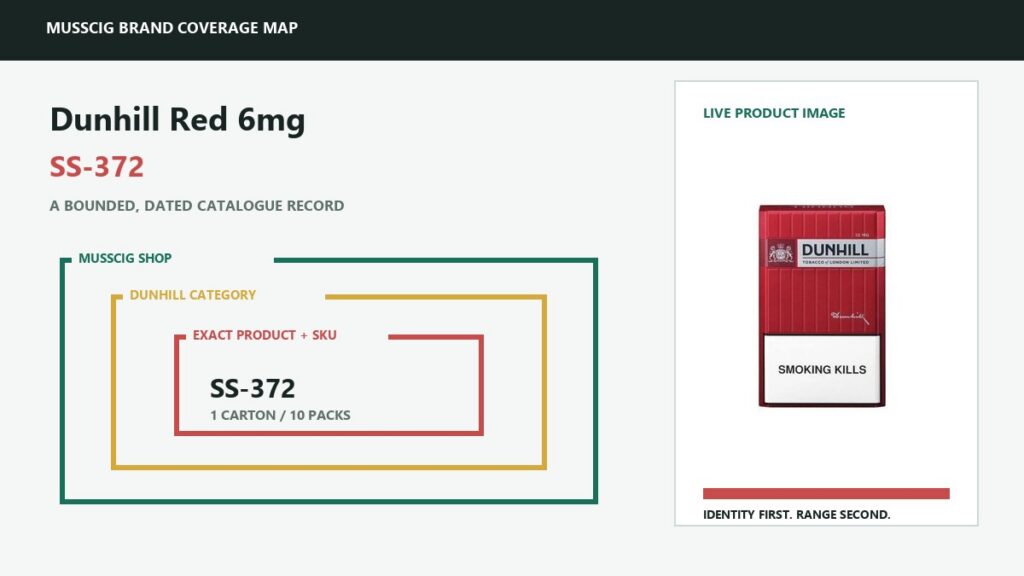
Brand coverage is not a claim that every possible product is present. It is a dated description of what the live catalogue lets a reviewer verify. On 11 August 2026, the exact Dunhill Red 6mg Cigarettes – 1 Carton (10 Packs) product record identified Dunhill Red 6mg Cigarettes – 1 Carton (10 Packs), SKU SS-372, as one carton containing 10 packs. The page displayed A$376.07 in AUD and an in stock state. Those fields establish one confirmed point inside the MussCig Dunhill set; they do not prove a complete range, permanent availability or a future price.
Define coverage before counting
A useful boundary has three levels. The first is the exact product identity, controlled by the final URL and SKU. The second is brand membership, shown by current category placement. The third is catalogue presence, checked through the wider Shop. Keeping these levels separate prevents a broad phrase such as Dunhill cigarettes from replacing the evidence for one particular variant.
| Coverage level | Evidence to record | What it can support |
|---|---|---|
| Exact record | Final product URL, full title and SKU | Identity of SS-372 |
| Brand set | Current Dunhill category placement | Membership observed on the review date |
| Store set | Product discoverable in the full catalogue | Current catalogue presence |
| Live conditions | AUD amount and stock label | A dated snapshot only |
Treat the SKU as the control key
The words Dunhill Red 6mg narrow the subject, but SS-372 is the strongest control key in this review. Record the SKU beside the complete title and one-carton unit. If a card uses similar wording without the same SKU, open it as a different candidate. Do not merge records because their packaging, colour words or category labels appear alike.
Use the category as membership evidence
Open the current Dunhill category and locate the card that resolves to the same identity. Category membership is useful because it connects the product to the site’s brand architecture. It remains a dated observation: products can be added, removed, renamed or reordered. Describe SS-372 as observed in the Dunhill category, not as proof that the displayed set is exhaustive.
Use Shop as a second catalogue check
The MussCig Shop provides a broader route that is independent of a single brand archive. Search or scan for the exact title and SKU, then open the final destination. A Shop card confirms discoverability only after the destination matches. It does not supply permission to shorten the title, reuse a neighbour’s price or infer details that are absent from the product page.
Separate identity from temporary conditions
Product identity and live conditions belong in different columns. The title, SKU, sale unit and final URL define what was reviewed. The A$376.07 AUD amount and in stock label describe what the page showed on 11 August 2026. If either live condition changes, append a new observation; do not rewrite the identity row or pretend the earlier condition never existed.
| Field group | Current record | Review rule |
|---|---|---|
| Identity | Dunhill Red 6mg Cigarettes – 1 Carton (10 Packs); SS-372 | Confirm against the final product page |
| Sale unit | 1 carton containing 10 packs | Keep attached to the exact listing |
| Price | A$376.07 AUD | Date the observation and recheck later |
| Stock | in stock | Do not predict quantity or replenishment |
Describe absent products conservatively
When a remembered Dunhill variant is not visible, the boundary record should say not observed in the checked category or Shop. That wording is narrower than discontinued, sold out everywhere or permanently removed. A route failure, cache difference, spelling change or new slug can also make an item hard to find, so absence needs its own investigation before it becomes a catalogue conclusion.
Keep neighbouring listings independent
Every Dunhill card needs its own identity bundle. A neighbouring title can show how the category is organised, but it cannot lend its image, SKU, price, stock state or carton wording to SS-372. This one-record rule also reduces keyword cannibalisation: the SS-372 article owns the exact product intent while broader brand pages retain range-navigation intent.
Check delivery at the policy layer
The Australia-only shipping policy is the source for destination scope and current delivery conditions. MussCig serves Australia only. Category membership, a visible price and an in-stock label do not establish eligibility for every address or promise a delivery time. Record policy review as a separate step rather than adding location claims to the product identity.
Keep return outcomes outside coverage
The returns and refunds policy explains the current process and conditions for return questions. Brand coverage cannot predict whether a particular request will be accepted. Review the policy in force at the relevant time and keep that evidence separate from the SKU, category and price fields.
Escalate mismatches with a compact record
If the title, SKU, category or final route conflicts, use the MussCig contact page with a concise evidence package: the complete product name, SKU SS-372, the final URL, review date and the single field that needs clarification. Do not include payment-card data, identity documents or unrelated personal information. A documented mismatch is preferable to selecting the nearest-looking product.
Build a repeatable boundary log
Future reviews should preserve the same order: open the exact product, confirm SKU and carton unit, test category membership, check Shop discoverability, record price and stock, then review policies. The result is a bounded statement that another reviewer can repeat. It supports what MussCig displayed on a specific date without turning a temporary catalogue view into a permanent range promise.
Keep the search intent unique
This page answers one question: how can a reviewer verify that SS-372 sits inside the current MussCig Dunhill catalogue boundary? It is not a buying guide, health comparison, delivery estimate or general Dunhill history. That narrow intent gives the article one preferred URL and leaves the existing brand-coverage basics, workflow and audit articles to explain their broader processes.
Adult catalogue notice
This MussCig brand-coverage record is for Australian adults aged 18 or older. Nicotine is addictive, and smoking causes serious health risks. The page documents catalogue evidence only and is not medical advice, a recommendation or a guarantee of price, stock, delivery or return outcomes.
Common questions
Does one SS-372 product prove the complete Dunhill range?
No. It proves that one exact product record was present during the dated check; the category must be reviewed separately and described as a current set.
Can a neighbouring Dunhill listing supply facts for SS-372?
No. A category neighbour may help navigation, but the final SS-372 URL, complete title, SKU and carton unit control this record.
Is A$376.07 a permanent part of the Dunhill boundary?
No. The AUD amount and stock label are dated conditions. The boundary log must check them again rather than carrying them forward as permanent facts.
What should happen when a Dunhill item is absent from the category?
Record it as not observed during that review. Do not call it discontinued, unavailable everywhere or removed permanently without separate evidence.